

Country profile
Costa Rica
República de Costa Rica
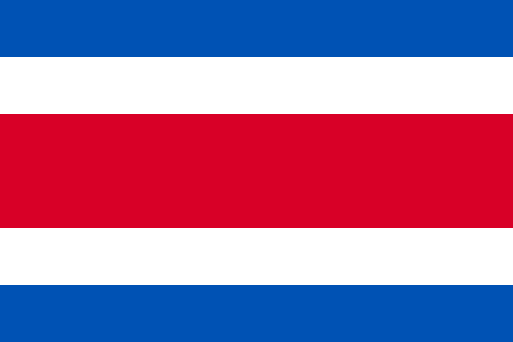
North America · Latin America and the Caribbean · Americas
CR · CRI
- Capital
- San José
- Population
- 5,309,625
- Area
- 51,100 km²
- Democracy index
- 72
- Regime type
- Fragmented Democracy
República de Costa Rica
North America · Latin America and the Caribbean · Americas
CR · CRI
Events
The latest elections, referendums, and opinion polls from Costa Rica. Community totals are not official results.
No public ballots yet
Check back later or explore the global feed.
Classification
The score and regime label are assigned by Porto Voto using our in-house democracy index and classification framework, not ratings from governments or external agencies.
Democracy index
72/100
Regime type
Fragmented Democracy
Costa Rica has long been a bastion of stability in Latin America, but recent developments under the political movement of Rodrigo Chaves and his successor, Laura Fernández, have strained democratic norms. Upon her inauguration on May 8, 2026, President Fernández appointed Chaves as a superministro holding both the Finance and Presidency portfolios, an unprecedented move that allows the former leader to retain immense executive influence and maintain legal immunity despite ongoing corruption investigations. This consolidation of power is coupled with an increasingly hostile environment for independent media, exemplified by the revocation of travel visas for the board of the critical newspaper La Nación by the United States, an action linked to the administration's close ties with the Trump presidency. While the electoral system remains functional and the judiciary historically independent, the executive branch has shown a growing tendency to bypass or confront other state institutions, including the Legislative Assembly and the Supreme Electoral Tribunal. High levels of popular support for the government's economic performance and its hardline security rhetoric coexist with a polarizing political atmosphere that has eroded the consensus-based governance model of previous decades. The current trajectory suggests a shift toward more centralized control and a narrowing of the space for dissent, placing the nation's robust democratic legacy under significant pressure.
Last evaluation:
How we classify regimes →World Factbook
A concise introduction to Costa Rica, together with notes on how power and law are organized, to put local ballots in context.
Although explored by the Spanish early in the 16th century, initial attempts at colonizing Costa Rica proved unsuccessful due to a combination of factors, including disease from mosquito-infested swamps, brutal heat, resistance from Indigenous populations, and pirate raids. It was not until 1563 that a permanent settlement of Cartago was established in the cooler, fertile central highlands. The area remained a colony for some two-and-a-half centuries.
In 1821, Costa Rica was one of several Central American provinces that jointly declared independence from Spain. Two years later it joined the United Provinces of Central America, but this federation disintegrated in 1838, at which time Costa Rica proclaimed its sovereignty and independence. Since the late 19th century, only two brief periods of violence have marred the country's democratic development.
General Federico TINOCO Granados led a coup in 1917, but the threat of US intervention pushed him to resign in 1919. In 1948, landowner Jose FIGUERES Ferrer raised his own army and rebelled against the government. The brief civil war ended with an agreement to allow FIGUERES to remain in power for 18 months, then step down in favor of the previously elected Otilio ULATE.
FIGUERES was later elected twice in his own right, in 1953 and 1970. Costa Rica experienced destabilizing waves of refugees from Central American civil wars in the 1970s and 1980s, but peace in the region has since helped the economy rebound. Although it still maintains a large agricultural sector, Costa Rica has expanded its economy to include strong technology and tourism industries.