

Country profile
Comoros
Udzima wa Komori (Comorian)/Union des Comores (French)/Al Ittihad al Qumuri (Arabic)
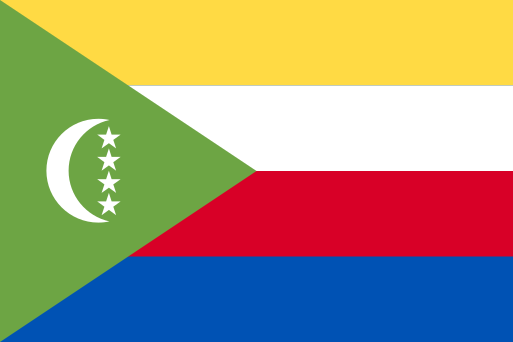
Africa · Sub-Saharan Africa
KM · COM
- Capital
- Moroni
- Population
- 919,901
- Area
- 1,862 km²
- Democracy index
- 30
- Regime type
- Electoral Autocracy
Udzima wa Komori (Comorian)/Union des Comores (French)/Al Ittihad al Qumuri (Arabic)
Africa · Sub-Saharan Africa
KM · COM
Events
The latest elections, referendums, and opinion polls from Comoros. Community totals are not official results.
No public ballots yet
Check back later or explore the global feed.
Classification
The score and regime label are assigned by Porto Voto using our in-house democracy index and classification framework, not ratings from governments or external agencies.
Democracy index
30/100
Regime type
Electoral Autocracy
Comoros is currently classified as an Electoral Autocracy, following the consolidation of power by President Azali Assoumani. Since the controversial 2024 presidential elections—which were marred by low turnout, opposition boycotts, and allegations of fraud—the political space has remained severely restricted. Assoumani’s administration has utilized constitutional amendments to extend presidential term limits and weaken the rotating presidency system that previously maintained stability between the islands of Grande Comore, Mohéli, and Anjouan. As of May 2026, the executive branch exerts significant control over the judiciary and the national electoral commission, effectively neutralizing any credible institutional challenge to the ruling party. Civil liberties are under pressure, with frequent bans on opposition gatherings and the periodic arrest of political activists. While the country maintains a facade of multi-partyism, the lack of a level playing field and the systematic marginalization of dissent mean that elections serve more as a mechanism for elite validation than a genuine exercise in popular sovereignty. The recent seizure of a Comoros-flagged vessel involved in international drug trafficking has further raised concerns regarding weak maritime oversight and potential institutional vulnerabilities within the state's regulatory framework.
Last evaluation:
How we classify regimes →World Factbook
A concise introduction to Comoros, together with notes on how power and law are organized, to put local ballots in context.
For centuries prior to colonization in the 19th century, the Comoros archipelago in the Indian Ocean served as a key node in maritime trade networks that connected the Middle East, India, and eastern African regions. Composed of the islands of Anjouan, Mayotte, Moheli, and Grande Comore, Comoros spent most of the 20th century as a colonial outpost until it declared independence from France on 6 July 1975. Residents of Mayotte, however, voted to remain in France, and the French Government has since classified it as a French Overseas Department.
Since independence, Comoros has weathered approximately 20 successful and attempted coups, mostly between 1975 and 2000, resulting in prolonged political instability and stunted economic development. In 2002, President AZALI Assoumani became the first elected president following the completion of the Fomboni Accords, in which the islands of Grande Comore, Anjouan, and Moheli agreed to rotate the presidency among the islands every five years. This power-sharing agreement also included provisions allowing each island to maintain its local government.
In 2007, Mohamed BACAR effected Anjouan's de-facto secession from the Union of the Comoros, refusing to step down when Comoros' other islands held legitimate elections. The African Union (AU) initially attempted to resolve the political crisis with sanctions and a naval blockade of Anjouan, but in 2008, the AU and Comoran soldiers seized the island. The island's inhabitants generally welcomed the move.
In 2011, Ikililou DHOININE won the presidency in peaceful elections widely deemed to be free and fair. In closely contested elections in 2016, AZALI won a second term, when the rotating presidency returned to Grande Comore. In 2018, a referendum -- which the opposition parties boycotted -- approved a new constitution that extended presidential term limits and abolished the requirement for the presidency to rotate between the three main islands.
AZALI formed a new government later that year, and he subsequently ran and was reelected in 2019. AZALI was reelected again in January 2024 in an election that the opposition disputed but the Supreme Court validated.