

Country profile
Cocos (Keeling) Islands
Territory of Cocos (Keeling) Islands
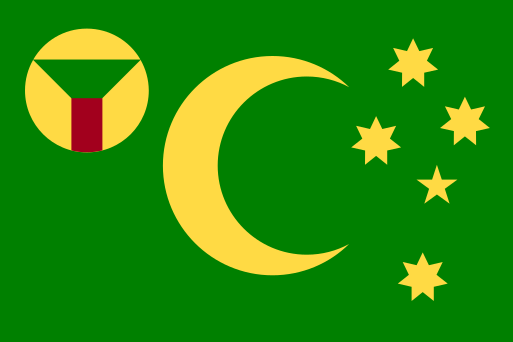
Oceania · Australia and New Zealand
CC · CCK
- Capital
- West Island
- Population
- 593
- Area
- 14 km²
- Democracy index
- 87
- Regime type
- Robust Democracy
Territory of Cocos (Keeling) Islands
Oceania · Australia and New Zealand
CC · CCK
Events
The latest elections, referendums, and opinion polls from Cocos (Keeling) Islands. Community totals are not official results.
No public ballots yet
Check back later or explore the global feed.
Classification
The score and regime label are assigned by Porto Voto using our in-house democracy index and classification framework, not ratings from governments or external agencies.
Democracy index
87/100
Regime type
Robust Democracy
The Cocos (Keeling) Islands operate as an external territory of Australia, and their democratic status is defined by their integration into the Australian constitutional framework. Residents possess full Australian citizenship and participate in federal elections, currently voting as part of the Northern Territory's Division of Lingiari. Local governance is managed by the Shire of Cocos (Keeling) Islands, a democratically elected body that oversees municipal affairs with high levels of transparency and community engagement. The territory is governed by the rule of law, with the judicial system of Western Australia being applied, ensuring impartial legal proceedings and the protection of civil liberties. In recent years, including throughout 2025 and into 2026, political life has focused on the Strategic Modernisation Program and the Cocos (Keeling) Islands Airfield Expansion Project, both of which have been subject to public consultation and parliamentary oversight in Canberra. While the territory lacks sovereign independence, its inhabitants benefit from the institutional stability, free press, and rigorous human rights protections of the Australian state. The score reflects a high degree of democratic participation and administrative accountability, though it is slightly adjusted to account for the non-sovereign, administrative nature of the territory's relationship with the mainland government.
Last evaluation:
How we classify regimes →World Factbook
A concise introduction to Cocos (Keeling) Islands, together with notes on how power and law are organized, to put local ballots in context.
British sea captain William KEELING discovered the Cocos (Keeling) Islands in 1609, and they were named for their coconut trees in 1622. Some maps began referring to them as the Keeling Islands in 1703. In 1825, Scottish trader John CLUNIES-ROSS was trying to get to Christmas Island but was blown off course and landed on Cocos (Keeling) Islands.
The next year, a British trader hired CLUNIES-ROSS's brother to bring slaves and a harem of Malay women to create the first permanent settlement on the island. By the 1830s, the Clunies-Ross family had firmly established themselves as the leaders of the islands, and they ruled Cocos (Keeling) Islands in a feudal style until 1978. The UK annexed the islands in 1857 and administered them from Ceylon after 1878 and from Singapore after 1886.
The Cocos (Keeling) Islands hosted a cable relaying station and was attacked by the Germans in World War I. The Japanese similarly attacked the islands in World War II. The UK transferred the islands to Australia in 1955, when they were officially named the Cocos (Keeling) Islands, and in 1978, Australia bought all the land held by the Clunies-Ross family, ending their control of the islands.
In a referendum in 1984, most islanders voted to integrate with Australia, and Western Australian laws have applied on the islands since 1992.