

Country profile
Chile
República de Chile
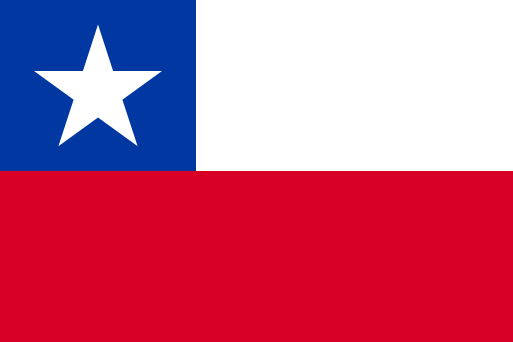
South America · Latin America and the Caribbean · Americas
CL · CHL
- Capital
- Santiago
- Population
- 20,206,953
- Area
- 756,102 km²
- Democracy index
- 86
- Regime type
- Robust Democracy
República de Chile
South America · Latin America and the Caribbean · Americas
CL · CHL
Events
The latest elections, referendums, and opinion polls from Chile. Community totals are not official results.
No public ballots yet
Check back later or explore the global feed.
Classification
The score and regime label are assigned by Porto Voto using our in-house democracy index and classification framework, not ratings from governments or external agencies.
Democracy index
86/100
Regime type
Robust Democracy
Chile remains a Robust Democracy as it enters a pivotal phase of institutional renewal following the significant 2025 general elections. The peaceful and organized transition of power from the administration of Gabriel Boric to a newly elected government has reaffirmed the country's commitment to democratic stability and the rule of law. While the earlier constitutional drafting processes in 2022 and 2023 were marked by deep polarization and consecutive rejections of proposed texts, the current political climate in 2026 suggests a shift toward pragmatic, incremental reform within the existing institutional framework. Public institutions, including the judiciary and the autonomous electoral authority, continue to operate with high levels of transparency and independence. Although social issues such as economic inequality and security in the southern regions remain sources of friction, they are addressed through established parliamentary and legal channels. The media landscape is diverse and free from systemic state interference, and civil society actively participates in the public sphere. The current index reflects Chile's enduring institutional strength and its ability to resolve fundamental political disagreements through consensus and democratic procedure rather than through extraconstitutional means.
Last evaluation:
How we classify regimes →World Factbook
A concise introduction to Chile, together with notes on how power and law are organized, to put local ballots in context.
Indigenous groups inhabited central and southern Chile for several thousand years, living in mixed pastoralist and settled communities. The Inca then ruled the north of the country for nearly a century prior to the arrival of the Spanish in the 16th century. In 1541, the Spanish established the Captaincy General of Chile, which lasted until Chile declared its independence in 1810.
The subsequent struggle with the Spanish became tied to other South American independence conflicts, with a decisive victory not being achieved until 1818. In the War of the Pacific (1879-83), Chile defeated Peru and Bolivia to win its current northernmost regions. By the 1880s, the Chilean central government cemented its control over the central and southern regions inhabited by Mapuche Indigenous peoples.
Between 1891 and 1973, a series of elected governments succeeded each other until the Marxist government of Salvador ALLENDE was overthrown in 1973 in a military coup led by General Augusto PINOCHET, who ruled until a democratically elected president was inaugurated in 1990. Economic reforms that were maintained consistently since the 1980s contributed to steady growth, reduced poverty rates by over half, and helped secure the country's commitment to democratic and representative government. Chile has increasingly assumed regional and international leadership roles befitting its status as a stable, democratic nation.