

Country profile
Central African Republic
République centrafricaine
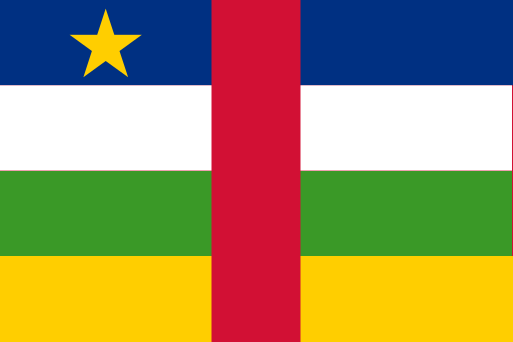
Africa · Sub-Saharan Africa
CF · CAF
- Capital
- Bangui
- Population
- 6,470,307
- Area
- 622,984 km²
- Democracy index
- 18
- Regime type
- Closed Autocracy
République centrafricaine
Africa · Sub-Saharan Africa
CF · CAF
Events
The latest elections, referendums, and opinion polls from Central African Republic. Community totals are not official results.
No public ballots yet
Check back later or explore the global feed.
Classification
The score and regime label are assigned by Porto Voto using our in-house democracy index and classification framework, not ratings from governments or external agencies.
Democracy index
18/100
Regime type
Closed Autocracy
The Central African Republic has increasingly consolidated into a Closed Autocracy following the 2023 constitutional referendum that abolished presidential term limits and paved the way for President Faustin Archange Touadéra's indefinite rule. As of May 2026, the political space is strictly controlled, with opposition movements effectively sidelined or suppressed through judicial and administrative means. The state's reliance on foreign paramilitary groups, most notably the Wagner Group (now rebranded under the Africa Corps), has further entrenched the executive branch by providing a security apparatus outside traditional institutional oversight. While a facade of legislative process exists, the judiciary lacks independence and is frequently used to silence dissent and consolidate power within the presidency. Civil liberties are significantly curtailed, and independent journalism faces severe risks, leading to a climate of self-censorship. Despite the government's claims of pursuing national reconciliation, large swaths of the territory remain under the control of armed groups, and the lack of accountable governance or competitive political mechanisms leaves the citizenry with no meaningful path for democratic participation.
Last evaluation:
How we classify regimes →World Factbook
A concise introduction to Central African Republic, together with notes on how power and law are organized, to put local ballots in context.
The Central African Republic (CAR) is a perennially weak state that sits at the crossroads of ethnic and linguistic groups in the center of the African continent. Among the last areas of Sub-Saharan Africa to be drawn into the world economy, its introduction into trade networks around the early 1700s fostered significant competition among its population. The local population sought to benefit from the lucrative Atlantic, trans-Saharan, and Indian Ocean trade in enslaved people and ivory.
Slave raids aided by the local populations fostered animosity between ethnic groups that remains today. The territory was established as a French colony named Ubangui-Shari in 1903, and France modeled its administration of the colony after the Belgian Congo, subcontracting control of the territory to private companies that collected rubber and ivory. Although France banned the domestic slave trade in CAR in the 1910s, the private companies continued to exploit the population through forced labor.
The colony of Ubangi-Shari gained independence from France as the Central African Republic in 1960, but the death of independence leader Barthelemy BOGANDA six months prior led to an immediate struggle for power. CAR’s political history has since been marred by a series of coups, the first of which brought Jean-Bedel BOKASSA to power in 1966. Widespread corruption and intolerance for any political opposition characterized his regime.
In an effort to prolong his mandate, BOKASSA named himself emperor in 1976 and changed the country’s name to the Central African Empire. His regime’s economic mismanagement culminated in widespread student protests in 1979 that were violently suppressed by security forces. BOKASSA fell out of favor with the international community and was overthrown in a French-backed coup in 1979.
After BOKASSA’s departure, the country’s name once again became the Central African Republic. CAR’s fifth coup in 2013 unseated President Francois BOZIZE after the Seleka, a mainly Muslim rebel coalition, seized the capital and forced BOZIZE to flee the country. The Seleka's widespread abuses spurred the formation of mainly Christian self-defense groups that called themselves the anti-Balaka, which have also committed human rights abuses against Muslim populations in retaliation.
Since the rise of these groups, conflict in CAR has become increasingly ethnoreligious, although focused on identity rather than religious ideology. Elections in 2016 installed independent candidate Faustin-Archange TOUADERA as president; he was reelected in 2020. A peace agreement signed in 2019 between the government and the main armed factions has had little effect, and armed groups remain in control of large swaths of the country's territory.
TOUADERA's United Hearts Movement has governed the country since 2016, and a new constitution approved by referendum on 30 July 2023 effectively ended term limits, creating the potential for TOUADERA to extend his rule.