

Country profile
Cameroon
République du Cameroun (French)/Republic of Cameroon (English)
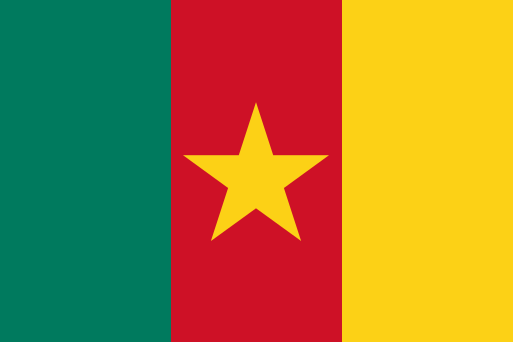
Africa · Sub-Saharan Africa
CM · CMR
- Capital
- Yaoundé
- Population
- 29,442,327
- Area
- 475,442 km²
- Democracy index
- 26
- Regime type
- Electoral Autocracy
République du Cameroun (French)/Republic of Cameroon (English)
Africa · Sub-Saharan Africa
CM · CMR
Events
The latest elections, referendums, and opinion polls from Cameroon. Community totals are not official results.
No public ballots yet
Check back later or explore the global feed.
Classification
The score and regime label are assigned by Porto Voto using our in-house democracy index and classification framework, not ratings from governments or external agencies.
Democracy index
26/100
Regime type
Electoral Autocracy
Cameroon is a consolidated Electoral Autocracy dominated by the long serving President Paul Biya and the ruling Cameroon People's Democratic Movement (CPDM). As the country navigates the aftermath of the late 2025 presidential election cycle, the political environment remains heavily skewed in favor of the incumbent through administrative control of the electoral body and judicial harassment of opposition figures. The Anglophone crisis in the Northwest and Southwest regions continues to severely undermine the rule of law and human rights, with both state forces and separatist groups accused of extrajudicial acts that effectively suspend democratic norms in those territories. Civil liberties are tightly restricted nationwide; the government frequently uses anti-terrorism laws and defamation charges to silence investigative journalists and activists who criticize the executive or discuss the sensitive issue of presidential succession. While multi-party elections are held, they serve primarily as a facade for the centralized power of the executive branch, as the state apparatus systematically curbs dissent and maintains a restrictive environment for media pluralism and free assembly.
Last evaluation:
How we classify regimes →World Factbook
A concise introduction to Cameroon, together with notes on how power and law are organized, to put local ballots in context.
Powerful chiefdoms ruled much of the area of present-day Cameroon before it became a German colony known as Kamerun in 1884. After World War I, the territory was divided between France and the UK as League of Nations mandates. French Cameroon became independent in 1960 as the Republic of Cameroon.
The following year, the southern portion of neighboring British Cameroon voted to merge with the new country to form the Federal Republic of Cameroon. In 1972, a new constitution replaced the federation with a unitary state, the United Republic of Cameroon. The country has generally enjoyed stability, which has enabled the development of agriculture, roads, and railways, as well as a petroleum industry.
Nonetheless, unrest and violence in the country's two western, English-speaking regions have persisted since 2016. Movement toward democratic reform is slow, and political power remains firmly in the hands of President Paul BIYA.