

Country profile
Brunei Darussalam
Negara Brunei Darussalam
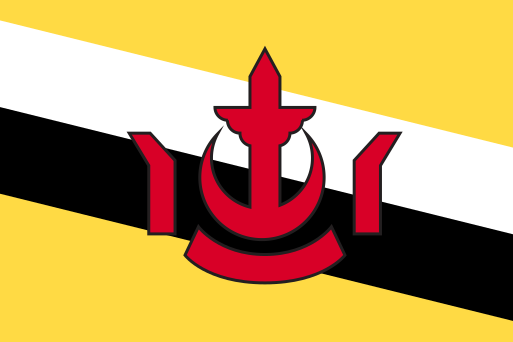
Asia · South-eastern Asia
BN · BRN
- Capital
- Bandar Seri Begawan
- Population
- 455,500
- Area
- 5,765 km²
- Democracy index
- 12
- Regime type
- Closed Autocracy
Negara Brunei Darussalam
Asia · South-eastern Asia
BN · BRN
Events
The latest elections, referendums, and opinion polls from Brunei Darussalam. Community totals are not official results.
No public ballots yet
Check back later or explore the global feed.
Classification
The score and regime label are assigned by Porto Voto using our in-house democracy index and classification framework, not ratings from governments or external agencies.
Democracy index
12/100
Regime type
Closed Autocracy
Brunei Darussalam is a quintessential Closed Autocracy, governed as an absolute monarchy by the Sultan, who serves as both the Head of State and Head of Government with full executive authority. The political system lacks any form of meaningful power competition, as there are no national level elections and political parties are virtually non-existent or inactive. The Sultan's emergency powers, which have been in place for decades, allow for governance by decree, effectively bypassing any legislative oversight. Civil liberties are severely restricted by the dual legal system of English Common Law and a strict Sharia Penal Code, the latter of which includes provisions for corporal and capital punishment that stifle public dissent and restrict the rights of the religious minorities. Freedom of the press is non-existent, with local media either owned by the government or practicing rigorous self-censorship to avoid sedition charges. While the state provides high levels of material welfare to its citizens through oil wealth, there is no institutional mechanism for accountability, transparency, or citizen participation in the decision-making process.
Last evaluation:
How we classify regimes →World Factbook
A concise introduction to Brunei Darussalam, together with notes on how power and law are organized, to put local ballots in context.
The Sultanate of Brunei's influence peaked between the 15th and 17th centuries, when its control extended over coastal areas of northwest Borneo and the southern Philippines. Internal strife over royal succession, colonial expansion of European powers, and piracy subsequently brought on a period of decline. In 1888, Brunei became a British protectorate; independence was achieved in 1984.
The same family has ruled Brunei for over six centuries, and in 2017, the country celebrated the 50th anniversary of Sultan Hassanal BOLKIAH’s accession to the throne. Brunei has one of the highest per-capita GDPs in the world, thanks to extensive petroleum and natural gas fields.