

Country profile
Benin
République du Benin
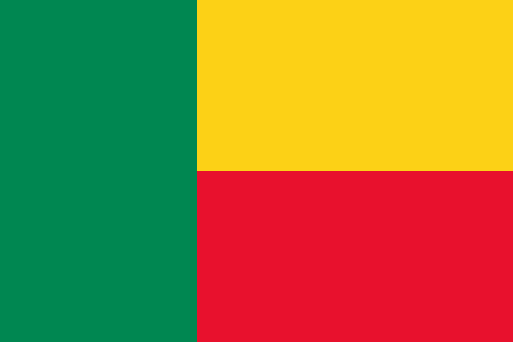
Africa · Sub-Saharan Africa
BJ · BEN
- Capital
- Porto-Novo
- Population
- 13,224,860
- Area
- 112,622 km²
- Democracy index
- 38
- Regime type
- Electoral Autocracy
République du Benin
Africa · Sub-Saharan Africa
BJ · BEN
Events
The latest elections, referendums, and opinion polls from Benin. Community totals are not official results.
No public ballots yet
Check back later or explore the global feed.
Classification
The score and regime label are assigned by Porto Voto using our in-house democracy index and classification framework, not ratings from governments or external agencies.
Democracy index
38/100
Regime type
Electoral Autocracy
Benin has transitioned into a system where the executive branch exerts nearly total control over the political landscape, a shift punctuated by the April 2026 presidential election. The victory of Romuald Wadagni, the handpicked successor of outgoing president Patrice Talon, occurred in an environment where major opposition figures remained largely sidelined or disqualified by restrictive electoral codes and judicial pressure. This follows a legislative cycle in January 2026 where pro government parties secured every seat in the National Assembly, effectively removing any parliamentary check on executive authority. Recent constitutional amendments that extended government terms and created a new senate have further consolidated the ruling party's grip, leading critics to describe the current state as a succession without genuine political change. While the outward forms of democracy, such as voting and party registration, are maintained, the systematic exclusion of dissent and the capture of state institutions have hollowed out the competitive core of the nation's formerly praised democratic model. Civil society continues to face a shrinking space for assembly, and the high turnout reported by official bodies contrasts with widespread reports of political apathy and fear among the electorate.
Last evaluation:
How we classify regimes →World Factbook
A concise introduction to Benin, together with notes on how power and law are organized, to put local ballots in context.
Present-day Benin is comprised of about 42 ethnic groups, including the Yoruba in the southeast, who migrated from what is now Nigeria in the 12th century; the Dendi in the north-central area, who came from Mali in the 16th century; the Bariba and the Fula in the northeast; the Ottamari in the Atakora mountains; the Fon in the area around Abomey in the south-central area; and the Mina, Xueda, and Aja, who came from Togo, on the coast. The Kingdom of Dahomey emerged on the Abomey plateau in the 17th century and was a regional power for much of the 18th and 19th centuries. The growth of Dahomey coincided with the growth of the Atlantic slave trade, and it became known as a major source of enslaved people.
France began to control the coastal areas of Dahomey in the second half of the 19th century; the entire kingdom was conquered by 1894. French Dahomey achieved independence in 1960, and it changed its name to the Republic of Benin in 1975. A succession of military governments ended in 1972 with the rise to power of Mathieu KEREKOU and a Marxist-Leninist government.
A move to representative government began in 1989. Two years later, free elections ushered in former Prime Minister Nicephore SOGLO as president, marking the first successful transfer of power in Africa from a dictatorship to a democracy. KEREKOU returned to power after elections in 1996 and 2001.
He stepped down in 2006 and was succeeded by Thomas YAYI Boni, a political outsider and independent, who won a second term in 2011. Patrice TALON, a wealthy businessman, took office in 2016; the space for pluralism, dissent, and free expression has narrowed under his administration. TALON won a second term in 2021.