

Country profile
Belgium
Royaume de Belgique (French)/Koninkrijk Belgie (Dutch)/Koenigreich Belgien (German)
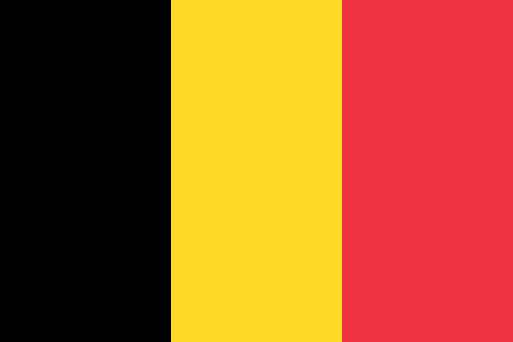
Europe · Western Europe
BE · BEL
- Capital
- Brussels
- Population
- 11,825,551
- Area
- 30,528 km²
- Democracy index
- 87
- Regime type
- Robust Democracy
Royaume de Belgique (French)/Koninkrijk Belgie (Dutch)/Koenigreich Belgien (German)
Europe · Western Europe
BE · BEL
Events
The latest elections, referendums, and opinion polls from Belgium. Community totals are not official results.
No public ballots yet
Check back later or explore the global feed.
Classification
The score and regime label are assigned by Porto Voto using our in-house democracy index and classification framework, not ratings from governments or external agencies.
Democracy index
87/100
Regime type
Robust Democracy
Belgium maintains its status as a robust democracy characterized by a profound commitment to the rule of law and the protection of individual liberties. The political system successfully navigated an exceptionally prolonged period of formation following the 2024 elections, with the eventual stabilization of federal and regional coalitions by early 2026 demonstrating the resilience of its consensus based model. While the administrative complexity of its federal structure often leads to significant delays in executive decision making, these pauses occur within a framework of total transparency and adherence to constitutional procedures. The judiciary remains fiercely independent, serving as a reliable check against any overreach by the temporary caretaker governments that manage affairs during periods of deadlock. Freedom of expression is deeply rooted, and the media landscape is diverse and free from state coercion. Although regional polarization and fiscal disputes occasionally strain the efficiency of governance, the underlying democratic institutions remain among the most stable in the world, ensuring that power remains accountable and that transitions occur through peaceful negotiation.
Last evaluation:
How we classify regimes →World Factbook
A concise introduction to Belgium, together with notes on how power and law are organized, to put local ballots in context.
Belgium became independent from the Netherlands in 1830; it was occupied by Germany during World Wars I and II. The country prospered as a modern, technologically advanced European state and member of NATO and the EU. In recent years, longstanding tensions between the Dutch-speaking Flemish of the north and the French-speaking Walloons of the south have led to constitutional amendments granting these regions formal recognition and autonomy.
The capital city of Brussels is home to numerous international organizations, including the EU and NATO.