

Country profile
Belarus
Respublika Byelarus' (Belarusian)/ Respublika Belarus' (Russian)
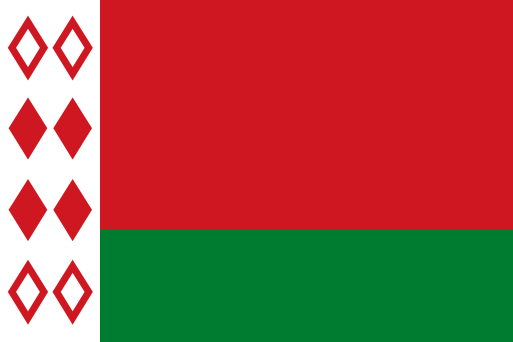
Europe · Eastern Europe
BY · BLR
- Capital
- Minsk
- Population
- 9,109,280
- Area
- 207,600 km²
- Democracy index
- 8
- Regime type
- Closed Autocracy
Respublika Byelarus' (Belarusian)/ Respublika Belarus' (Russian)
Europe · Eastern Europe
BY · BLR
Events
The latest elections, referendums, and opinion polls from Belarus. Community totals are not official results.
No public ballots yet
Check back later or explore the global feed.
Classification
The score and regime label are assigned by Porto Voto using our in-house democracy index and classification framework, not ratings from governments or external agencies.
Democracy index
8/100
Regime type
Closed Autocracy
Belarus remains a consolidated autocracy where political power is absolute and concentrated within the executive and the supporting security apparatus. The landscape for independent activity has been effectively cleared, with all major opposition figures either imprisoned, in exile, or forced into silence. The 2024 parliamentary and local elections, followed by the continued integration with Russian security frameworks through 2025 and into 2026, have further cemented the state's departure from any democratic norms. Civil society has been systematically liquidated, and the media environment is entirely dominated by state propaganda or forced into operating from abroad. The judiciary functions as a mechanism for political repression, regularly handing down severe sentences for any form of dissent, including private social media activity. Fundamental rights such as freedom of assembly and association are non-existent in practice, as the state maintains a zero tolerance policy toward unsanctioned public expression. This environment of total control and the absence of institutional checks ensure that the regime remains one of the most restrictive in the world, with no functional path for legitimate political competition.
Last evaluation:
How we classify regimes →World Factbook
A concise introduction to Belarus, together with notes on how power and law are organized, to put local ballots in context.
After seven decades as a constituent republic of the USSR, Belarus attained its independence in 1991. It has retained closer political and economic ties to Russia than any of the other former Soviet republics. In 1999, Belarus and Russia signed a treaty on a two-state union, envisioning greater political and economic integration.
Although Belarus agreed to a framework to carry out the accord, serious implementation has yet to take place and negotiations on further integration have been contentious. Since taking office in 1994 as the country's first and only directly elected president, Alyaksandr LUKASHENKA has steadily consolidated his power through authoritarian means and a centralized economic system. Government restrictions on political and civil freedoms, freedom of speech and the press, peaceful assembly, and religion have remained in place.
Restrictions on political freedoms have tightened in the wake of the disputed presidential election in 2020. The election results sparked large-scale protests as members of the opposition and civil society criticized the election’s validity. LUKASHENKA has remained in power as the disputed winner of the presidential election after quelling protests in 2020.
Since 2022, Belarus has facilitated Russia's war in Ukraine, which was launched in part from Belarusian territory.