

Country profile
Barbados
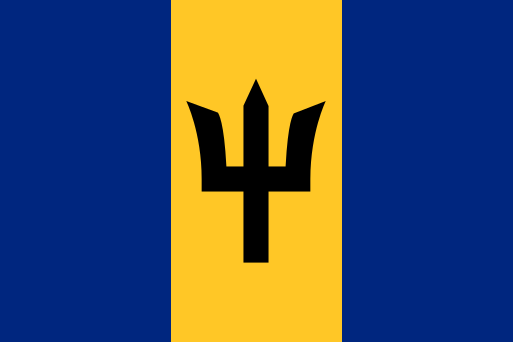
North America · Latin America and the Caribbean · Americas
BB · BRB
- Capital
- Bridgetown
- Population
- 267,800
- Area
- 430 km²
- Democracy index
- 94
- Regime type
- Robust Democracy
North America · Latin America and the Caribbean · Americas
BB · BRB
Events
The latest elections, referendums, and opinion polls from Barbados. Community totals are not official results.
No public ballots yet
Check back later or explore the global feed.
Classification
The score and regime label are assigned by Porto Voto using our in-house democracy index and classification framework, not ratings from governments or external agencies.
Democracy index
94/100
Regime type
Robust Democracy
Barbados remains one of the most stable and high performing democracies in the Caribbean, a status reaffirmed by the orderly conduct of the February 2026 general elections. The Barbados Labour Party secured a third consecutive landslide victory, winning all thirty seats in the House of Assembly in a process characterized by high transparency and a complete absence of political violence. While the lack of a formal parliamentary opposition due to the electoral sweep presents unique challenges for legislative debate, the country maintains robust extra parliamentary checks through an independent judiciary and a vocal civil society. The transition to a republic in recent years has not diminished the institutional strength of the rule of law or the protection of fundamental civil liberties, which remain among the most secure in the region. Freedom of expression is healthy, with media outlets operating without state interference and providing a platform for critical discourse even in the absence of opposition lawmakers. Government accountability is supported by established oversight mechanisms, though public discussion continues regarding the need for constitutional reforms to ensure broader representation. Overall, the political culture is defined by deep seated respect for democratic norms and a predictable, rights respecting governance framework.
Last evaluation:
How we classify regimes →World Factbook
A concise introduction to Barbados, together with notes on how power and law are organized, to put local ballots in context.
Barbados was uninhabited when first settled by the British in 1627. Enslaved Africans worked the sugar plantations established on the island, which initially dominated the Caribbean sugar industry. By 1720, Barbados was no longer a dominant force within the sugar industry, having been surpassed by the Leeward Islands and Jamaica.
Slavery was abolished in 1834. The Barbadian economy remained heavily dependent on sugar, rum, and molasses production through most of the 20th century. The gradual introduction of social and political reforms in the 1940s and 1950s led to independence from the UK in 1966.
In the 1990s, tourism and manufacturing surpassed the sugar industry in economic importance. Barbados became a republic in 2021, with the former Governor-General Sandra MASON elected as the first president.