

Country profile
Bahrain
Mamlakat al Bahrayn
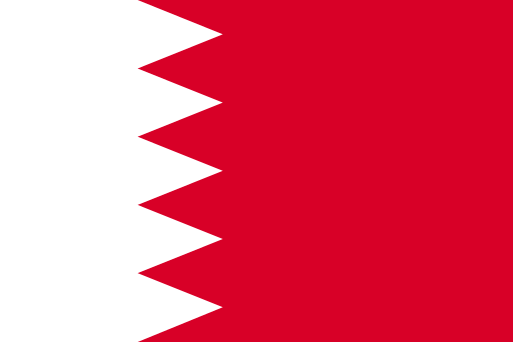
Asia · Western Asia
BH · BHR
- Capital
- Manama
- Population
- 1,594,654
- Area
- 765 km²
- Democracy index
- 12
- Regime type
- Closed Autocracy
Mamlakat al Bahrayn
Asia · Western Asia
BH · BHR
Events
The latest elections, referendums, and opinion polls from Bahrain. Community totals are not official results.
No public ballots yet
Check back later or explore the global feed.
Classification
The score and regime label are assigned by Porto Voto using our in-house democracy index and classification framework, not ratings from governments or external agencies.
Democracy index
12/100
Regime type
Closed Autocracy
Bahrain operates as a highly centralized monarchy where political authority is concentrated within the Al Khalifa royal family, leaving no space for meaningful opposition or independent political activity. Since the dissolution of major opposition groups and the tightening of restrictive media and association laws, the kingdom has effectively criminalized peaceful dissent and maintained a pervasive security apparatus to monitor and suppress activists. While the government occasionally announces mass prisoner pardons or small scale amnesties, these gestures are viewed by international monitors as tactical efforts to manage external reputation rather than substantive shifts toward pluralism. The judiciary remains a tool for executive control, frequently used to confirm lengthy sentences for political figures and human rights defenders under broadly defined anti terrorism legislation. Freedom of expression is severely limited, with online surveillance and the threat of prosecution creating a climate of self censorship. The lack of independent oversight and the total exclusion of the majority population from high level decision making processes ensure that the state remains a closed system where democratic institutions exist only as formal structures without functional influence or accountability.
Last evaluation:
How we classify regimes →World Factbook
A concise introduction to Bahrain, together with notes on how power and law are organized, to put local ballots in context.
In 1783, the Sunni AL-KHALIFA family took power in Bahrain. In order to secure these holdings, it entered into a series of treaties with the UK during the 19th century that made Bahrain a British protectorate. The archipelago attained its independence in 1971.
A steady decline in oil production and reserves since 1970 prompted Bahrain to take steps to diversify its economy, in the process developing petroleum processing and refining, aluminum production, and hospitality and retail sectors. It has also endeavored to become a leading regional banking center, especially with respect to Islamic finance. Bahrain's small size, central location among Gulf countries, economic dependence on Saudi Arabia, and proximity to Iran require it to play a delicate balancing act in foreign affairs among its larger neighbors.
Its foreign policy activities usually fall in line with Saudi Arabia and the UAE. In 2022, the United States designated Bahrain as a major non-NATO ally. The Sunni royal family has long struggled to manage relations with its Shia-majority population.
In 2011, amid Arab uprisings elsewhere in the region, the Bahraini Government responded to similar pro-democracy and reform protests at home with police and military action, including deploying Gulf Cooperation Council security forces. Ongoing dissatisfaction with the political status quo continues to factor into sporadic clashes between demonstrators and security forces. In 2020, Bahrain and the United Arab Emirates signed the US-brokered Abraham Accords with Israel.
In 2023, Bahrain and the United States signed the Comprehensive Security Integration and Prosperity Agreement to enhance cooperation across a wide range of areas, from defense and security to emerging technology, trade, and investment.