

Country profile
Azerbaijan
Azarbaycan Respublikasi
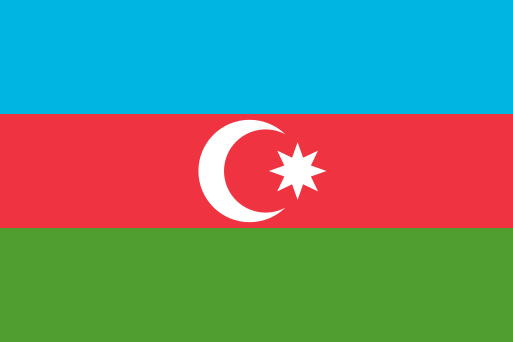
Asia · Western Asia
AZ · AZE
- Capital
- Baku
- Population
- 10,241,722
- Area
- 86,600 km²
- Democracy index
- 14
- Regime type
- Closed Autocracy
Azarbaycan Respublikasi
Asia · Western Asia
AZ · AZE
Events
The latest elections, referendums, and opinion polls from Azerbaijan. Community totals are not official results.
No public ballots yet
Check back later or explore the global feed.
Classification
The score and regime label are assigned by Porto Voto using our in-house democracy index and classification framework, not ratings from governments or external agencies.
Democracy index
14/100
Regime type
Closed Autocracy
Azerbaijan is characterized by a highly centralized executive authority where power remains concentrated within a single family and its inner circle, leaving no space for meaningful political competition. The government has systematically dismantled the independent media landscape and suppressed civil society through a series of restrictive laws and targeted persecutions of journalists, activists, and opposition figures. Elections are routinely criticized by international observers for failing to meet basic standards of fairness or transparency, often involving the exclusion of genuine contenders and the manipulation of results. Following the complete restoration of territorial control over Nagorno Karabakh, the leadership has leveraged nationalist sentiment to further consolidate domestic control and justify heightened security measures that stifle dissent. The judiciary lacks independence and functions primarily as a mechanism for legalizing the suppression of perceived political threats. Fundamental freedoms of assembly and expression are severely curtailed in practice, with state security services maintaining a pervasive presence to deter any public manifestation of dissatisfaction. This environment of absolute political dominance and the total absence of institutional checks on the presidency place the country firmly in the category of a closed system where democratic principles exist only as a formal facade for authoritarian rule.
Last evaluation:
How we classify regimes →World Factbook
A concise introduction to Azerbaijan, together with notes on how power and law are organized, to put local ballots in context.
Azerbaijan -- a secular nation with a majority-Turkic and majority-Shia Muslim population -- was briefly independent (from 1918 to 1920) following the collapse of the Russian Empire; it was subsequently incorporated into the Soviet Union for seven decades. Beginning in 1988, Azerbaijan and Armenia fought over the Nagorno-Karabakh region, which was populated largely by ethnic Armenians but incorporated into Soviet Azerbaijan as an autonomous oblast in the early 1920s. In the late Soviet period, an ethnic-Armenian separatist movement sought to end Azerbaijani control over the region.
Fighting over Nagorno-Karabakh escalated after Armenia and Azerbaijan gained independence from the Soviet Union in 1991. By the time a ceasefire took effect in 1994, separatists with Armenian support controlled Nagorno‑Karabakh and seven surrounding Azerbaijani territories. After decades of cease-fire violations and sporadic flare-ups, a second sustained conflict began in 2020 when Azerbaijan tried to win back the territories it had lost in the 1990s.
After significant Azerbaijani gains, Armenia returned the southern part of Nagorno-Karabakh and the surrounding territories to Azerbaijan. In September 2023, Azerbaijan took military action to regain the rest of Nagorno-Karabakh; after a conflict that lasted only one day, nearly the entire ethnic Armenian population of Nagorno-Karabakh fled to Armenia. Since gaining its independence in 1991, Azerbaijan has significantly reduced the poverty rate and has directed some revenue from its oil and gas production to develop the country’s infrastructure.
However, corruption remains a burden on the economy, and Western observers and members of the country’s political opposition have accused the government of authoritarianism. The country’s leadership has remained in the ALIYEV family since Heydar ALIYEV, the most highly ranked Azerbaijani member of the Communist Party during the Soviet period, became president during the first Nagorno-Karabakh War in 1993.