

Country profile
Austria
Republik Oesterreich
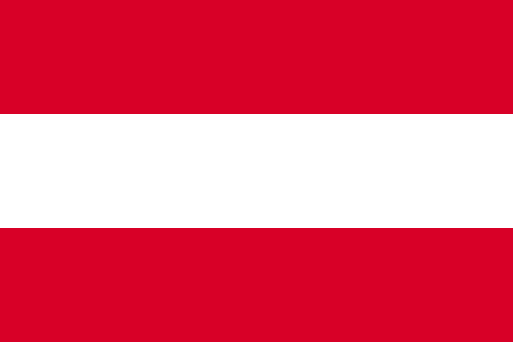
Europe · Western Europe
AT · AUT
- Capital
- Vienna
- Population
- 9,200,931
- Area
- 83,871 km²
- Democracy index
- 89
- Regime type
- Robust Democracy
Republik Oesterreich
Europe · Western Europe
AT · AUT
Events
The latest elections, referendums, and opinion polls from Austria. Community totals are not official results.
No public ballots yet
Check back later or explore the global feed.
Classification
The score and regime label are assigned by Porto Voto using our in-house democracy index and classification framework, not ratings from governments or external agencies.
Democracy index
89/100
Regime type
Robust Democracy
Austria maintains a high level of institutional stability characterized by a strong rule of law and a consistently independent judiciary that effectively checks executive power. The political system is defined by transparent and competitive electoral processes where multiple parties represent a broad spectrum of ideologies and power transfers occur without dispute. While the country has navigated periods of political friction and coalition instability in recent years, the resilience of its constitutional framework ensures that civil liberties and freedom of the press remain robustly protected. Media pluralism is high, although certain debates continue regarding the influence of government advertising on private outlets. Oversight bodies and anti corruption mechanisms are active and functional, frequently leading to high profile investigations that demonstrate accountability even at the senior levels of government. Public trust in democratic institutions remains solid, supported by a political culture that prioritizes consensus and adherence to established legal norms. The state consistently provides a safe environment for dissent and civic engagement, reinforcing its position as a stable and rights respecting democracy within the European framework.
Last evaluation:
How we classify regimes →World Factbook
A concise introduction to Austria, together with notes on how power and law are organized, to put local ballots in context.
Once the center of power for the large Austro-Hungarian Empire, Austria was reduced to a small republic after its defeat in World War I. Nazi Germany annexed Austria in 1938, and the victorious Allies then occupied the country in 1945. As a result, Austria's status remained unclear for a decade after World War II, until a State Treaty signed in 1955 ended the occupation, recognized Austria's independence, and forbade unification with Germany.
A constitutional law that same year declared the country's "perpetual neutrality" as a condition for Soviet military withdrawal. Austria joined the EU in 1995, but the obligation to remain neutral kept it from joining NATO, although the country became a member of NATO's Partnership for Peace program in 1995. Austria entered the EU Economic and Monetary Union in 1999.