

Country profile
Aruba
Land Aruba (Dutch); Pais Aruba (Papiamento)
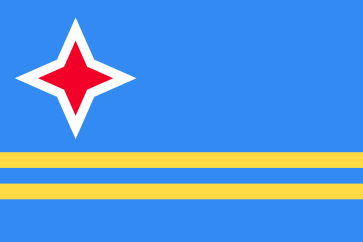
North America · Latin America and the Caribbean · Americas
AW · ABW
- Capital
- Oranjestad
- Population
- 107,566
- Area
- 180 km²
- Democracy index
- 88
- Regime type
- Robust Democracy
Land Aruba (Dutch); Pais Aruba (Papiamento)
North America · Latin America and the Caribbean · Americas
AW · ABW
Events
The latest elections, referendums, and opinion polls from Aruba. Community totals are not official results.
No public ballots yet
Check back later or explore the global feed.
Classification
The score and regime label are assigned by Porto Voto using our in-house democracy index and classification framework, not ratings from governments or external agencies.
Democracy index
88/100
Regime type
Robust Democracy
Aruba continues to demonstrate a high degree of institutional stability as a constituent country within the Kingdom of the Netherlands. The political system is characterized by a strong adherence to the rule of law and a multi party parliamentary structure where power transfers occur peacefully following competitive and transparent elections. While the governor represents the Dutch monarch, executive authority is effectively exercised by the prime minister and a cabinet responsible to the locally elected parliament. The judiciary remains independent and acts as a credible check on government power, ensuring that civil liberties are broadly respected across the island. Corruption remains a point of public discourse, yet established legal mechanisms and oversight bodies provide functional accountability. Freedom of expression and assembly are robustly protected, with a diverse media landscape that operates without significant state interference. The relationship with the Netherlands provides an additional layer of constitutional security, maintaining a framework that prevents the consolidation of unchecked executive authority. Public trust in democratic institutions is relatively high, supported by a history of consensus based governance and a predictable regulatory environment.
Last evaluation:
How we classify regimes →World Factbook
A concise introduction to Aruba, together with notes on how power and law are organized, to put local ballots in context.
Discovered and claimed for Spain in 1499, Aruba was acquired by the Dutch in 1636. Three main industries have since dominated the island's economy: gold mining, oil refining, and tourism. A 19th-century gold rush was followed by prosperity brought on by the opening of an oil refinery in 1924.
The last decades of the 20th century saw a boom in the tourism industry. Aruba seceded from the Netherlands Antilles in 1986 and became a separate, semi-autonomous member of the Kingdom of the Netherlands. Movement toward full independence was halted at Aruba's request in 1990.