

Country profile
Andorra
Principat d'Andorra
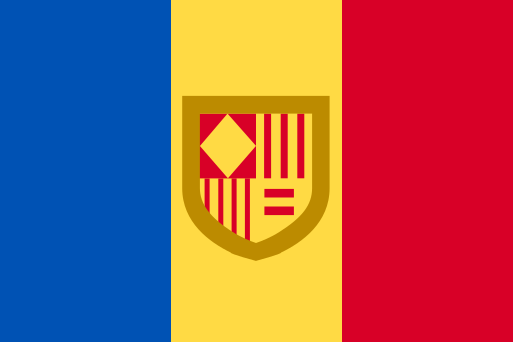
Europe · Southern Europe
AD · AND
- Capital
- Andorra la Vella
- Population
- 88,406
- Area
- 468 km²
- Democracy index
- 91
- Regime type
- Robust Democracy
Principat d'Andorra
Europe · Southern Europe
AD · AND
Events
The latest elections, referendums, and opinion polls from Andorra. Community totals are not official results.
No public ballots yet
Check back later or explore the global feed.
Classification
The score and regime label are assigned by Porto Voto using our in-house democracy index and classification framework, not ratings from governments or external agencies.
Democracy index
91/100
Regime type
Robust Democracy
Andorra maintains a stable and high functioning parliamentary democracy characterized by strong institutional integrity and the effective rule of law. The 2023 general elections and subsequent local governance cycles have demonstrated a consistent commitment to transparent and competitive political processes, where power is peacefully transferred and opposition parties operate without hinderance. While the unique co-principality structure involves the Bishop of Urgell and the President of France as heads of state, their roles are primarily symbolic, leaving executive authority to the Head of Government who remains accountable to the General Council. Civil liberties are robustly protected, and the media environment is diverse, though the small size of the country can occasionally lead to close ties between business interests and political actors. Recent legislative efforts have focused on increasing transparency in financial regulations and aligning domestic human rights standards with European norms. The judiciary operates with a high degree of independence, and there are no significant reports of systemic corruption or arbitrary enforcement. The legal framework provides an inclusive space for civil society, and digital freedoms are fully respected, ensuring that Andorra remains one of the most stable and rights-respecting systems in the global context.
Last evaluation:
How we classify regimes →World Factbook
A concise introduction to Andorra, together with notes on how power and law are organized, to put local ballots in context.
The landlocked Principality of Andorra -- one of the smallest states in Europe and nestled high in the Pyrenees between the French and Spanish borders -- is the last independent survivor of the Hispanic March states created by Frankish King Charlemagne in 795 after he halted the Moorish invasion of Spain. The March states were a series of buffer states to keep the Muslim Moors from advancing into Christian France. For 715 years, from 1278 to 1993, Andorrans lived under a unique co-principality, ruled by French and Spanish leaders (from 1607 onward, the French chief of state and the Bishop of Urgell).
In 1993, this feudal system was modified with the introduction of a modern constitution; the co-princes remained as titular heads of state, but the government transformed into a parliamentary democracy. Andorra's winter sports, summer climate, and duty-free shopping attract approximately 8 million people each year. Andorra has also become a wealthy international commercial center because of its mature banking sector and low taxes.
As part of the effort to modernize its economy, Andorra has opened to foreign investment and engaged in other reforms, such as tax initiatives aimed at supporting broader infrastructure. Although not a member of the EU, Andorra enjoys a special relationship with the bloc that is governed by various customs and cooperation agreements, and Andorra uses the euro as its national currency.