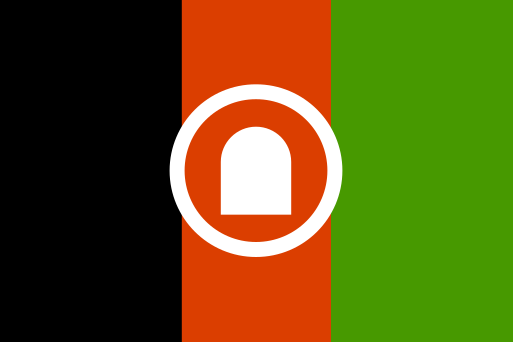
Afghanistan
Jamhuri-ye Islami-ye Afghanistan (prior to 15 August 2021; current country name is disputed)
Asia · Southern Asia
AF · AFG
- Capital
- Kabul
- Population
- 43,844,000
- Area
- 652,230 km²
- Democracy index
- 7
- Regime type
- Closed Autocracy
Jamhuri-ye Islami-ye Afghanistan (prior to 15 August 2021; current country name is disputed)
Asia · Southern Asia
AF · AFG
Events
The latest elections, referendums, and opinion polls from Afghanistan. Community totals are not official results.
No public ballots yet
Check back later or explore the global feed.
Classification
The score and regime label are assigned by Porto Voto using our in-house democracy index and classification framework, not ratings from governments or external agencies.
Democracy index
7/100
Regime type
Closed Autocracy
Afghanistan remains a consolidated closed autocracy under the absolute authority of the Taliban leadership based in Kandahar. The de facto government has systematically dismantled all democratic institutions, including the independent judiciary and electoral commissions, replacing them with a strict theocratic framework. Political rights and civil liberties are effectively nonexistent, with the regime enforcing severe restrictions on expression, assembly, and movement. Of particular concern is the institutionalized gender persecution, where women and girls are excluded from nearly all public life and education. Recent developments in early 2026 include the codification of the Criminal Procedural Regulation of the Courts, which formalizes a social hierarchy for legal punishment and grants judges broad discretion to apply corporal measures. While the Taliban maintains territorial control and a monopoly on force, preventing a transition into the failed state category, the complete absence of pluralism and the intensification of surveillance and coercion solidify its position at the lowest end of the closed autocracy spectrum.
Last evaluation:
How we classify regimes →World Factbook
A concise introduction to Afghanistan, together with notes on how power and law are organized, to put local ballots in context.
Ahmad Shah DURRANI unified the Pashtun tribes and founded Afghanistan in 1747. The country served as a buffer between the British and Russian Empires until it won independence from notional British control in 1919. A brief experiment in increased democracy ended in a 1973 coup and a 1978 communist countercoup.
The Soviet Union invaded in 1979 to support the tottering Afghan communist regime, touching off a long and destructive war. Internationally supported anti-communist mujahidin rebels forced the USSR to withdraw in 1989. A series of subsequent civil wars saw Kabul finally fall in 1996 to the Taliban, a hardline Pakistani-sponsored movement.
Following the 11 September 2001 terrorist attacks, a US and Allied military action toppled the Taliban for sheltering Usama BIN LADIN. A UN-sponsored Bonn Conference in 2001 established a process for political reconstruction that included the adoption of a new constitution, a presidential election in 2004, and National Assembly elections in 2005. In 2004, Hamid KARZAI became the first democratically elected president of Afghanistan, and he was reelected in 2009.
Ashraf Ghani AHMADZAI succeeded him as president in 2014 following a disputed election. The Taliban conducted an insurgency for two decades against the Afghan Government and forces from the United States and other countries. In February 2020, the US and the Taliban signed an agreement that led to the withdrawal of international forces in exchange for commitments on counterterrorism and other assurances.
The Taliban took over Afghanistan on 15 August 2021. The Taliban established an all-male interim leadership structure dominated by Pashtun clerics under the leadership of Haivatrullah AKHUNDZADA. The Taliban issued numerous edicts that constrained women's mobility, ability to study and work, and access to education beyond primary school.
To date, no country has recognized the Taliban as the government of Afghanistan.